Posts

Showing posts with the label climate

Energy Price Concerns Resonate in EU Talks on 2030 Climate Goals

Image
-- a _kt75 | reprint Inside Sustainability: Facts, Figures, Bullshit - Part II: Alternative Energy The European Union should ensure that future climate and energy policies do not undermine the competitiveness of its industry, already weakened by a price gap with the U.S., the bloc’s member states said. Energy ministers from the EU’s 28 nations had their first debate about 2030 carbon-reduction andrenewable energy strategy at their quarterly meeting in Brussels today. It followed yesterday’s gathering of environment ministers, where countries differed over how ambitious Europe’s emissions-cut target should be and how fast new policies should be adopted. The framework for the next decade will next be discussed by EU leaders at their March 20-21 summit. “We need to make sure we combine our objectives for setting ambitious goals with increasing competitveness of the industry and safeguarding energy supply,” Greek E...
Black or White? Why Germany's 'Energy Turnaround' needs Reconsideration

Image
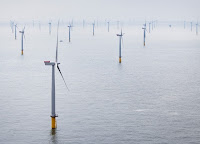
-- a _kt75 | reprint     Tweet The cornerstones of Germany's energy turn-around can be admired in a hall in the northern port city of Bremerhaven. Standing on three rust-brown feet apiece, each of these immense, yellow-painted trunks weighs as much as 900 elephants. Soon, special ships will come and sink these steel monsters into the seabed, where they will support the wind turbines that are supposed to supply the country with green electricity. Before they do, Environment Minister Peter Altmaier will go to Bremerhaven to inspect the work of Weser Wind and Areva Wind, the companies building them. Areva calls these wind-turbine supports "tripods." Peter Altmeier has a more poetic term, dubbing them "cathedrals to industrial culture." This last week, there was a strict division of labor at several locations around the country. From Monday to Wednesday, the environment minister went on a whirlwind tour of Germa...

Iran Abandons Chinese Help, to Build World’s Highest Hydroelectric Plant Alone

Image
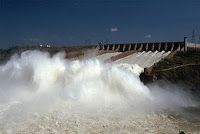
-- a _kt75 | reprint    Iran, pummeled by years of international sanctions, has had two energy goals. First, to preserve its dwindling international hydrocarbon market share, increasingly battered by years of U.S. and UN sanctions designed to slow down and halt its civilian nuclear energy program, which Washington and Tel Aviv have long insisted masks a covert program to develop a nuclear weapons program. The second, much less reported in the foreign press, is to diversify its indigenous energy infrastructure, so as to preserve its hydrocarbon assets for the long term. In pursuit of the latter goal, Iran is ramping up its hydroelectric program. Iran currently has 23 operational hydropower plants, with a combined electricity generating capacity of 8.2 gigawatts, 14 percent of the nation’s total generating capacity of 58.5 gigawatts. A further 4.8 gigawatts of capacity is under construction, with 12.7 gigawatts of hydro capacity is either u...

water shortages III: challenges, opportunities and limitations of water supply through aquifers

Image
-- a note from kt75 In the past a number of articles addressed the issue of water shortages especially in Mid-East [ 1 ]- [ 4 ]. Focus in this region is on the Jordan valley and in particular on the so-called Disi-Aquifer [ 5 ], [ 6 ]. Accordingly, and despite the fact that the Disi-Aquifer constitutes an almost non-renewable water resource (fossil water) the exploitation seems to have started seriously [ 5 ], [ 7 ]. This obviously also due to social pressure (refugees from Syria) [ 8 ], [ 9 ]. All this affects the water supply conditions in the Mid-East region adversely [ 10 ]-[ 12 ] and represents a huge challenge in terms of political and economic decision making [ 13 ], [ 14 ]. Most importantly is certainly the insight that fossil water resources represent non-renewable water sources. They may help facilitate safe water supply for a short time but (due to almost nonexistent replenishment) may not be considered as durable long-term water supply alternative. Further read...

thawing marine ice, thawing glaciers - effects, impacts, consequences: a brief summary

Image
-- a note from kt75 A number of recent studies on the towing of arctic sea-ice report new all-time lows of ice coverage [ 1 ]- [ 4 ]. Similar effects have been reported previously for glaciers, e.g. in the Swiss Alps [ 5 ], [ 6 ]. The global warming (climate change) has been identified as one of the primary reasons for the reduction in ice-coverage with obvious consequences, e.g. for regional and local weather conditions. In addition to this economic implications are expected as well [ 7 ]-[ 9 ].  Further readings: [ 1 ], [ 2 ], [ 3 ], [ 4 ], [ 5 ], [ 6 ], [ 7 ], [ 8 ], [ 9 ] kt75 :  http://kt-75.blogspot.ch/

Sustainability Critics II: Growth

Image
-- an SWM THiNKTANK article edited: 2012-05-25 (ws), Sustainability and 'growth' (as observed and interpreted today) is a contradiction. The first term has (under today's conditions) nothing to do with the latter and vice versa. Why is this the case? First of all 'growth' (up to now and prevailing) refers to a purely quantitative growth. For example, the GDP [ 1 ], mobility growth [ 2 ], car market growth [ 3 ]-[ 6 ], profit growth [ 7 ], unemployment growth [ 8 ]. A return to growth (away from the current 'anemic growth' [ 9a ]-[ 9c ]) is reported [e.g. 9 ] which, however, may have disadvantageous consequences, i.e. another growth in CO2-emissions despite a decrease [ 10 ]. The list could easily be expanded.  The overall impression from the above brief list however is, that the society is inescapable doomed to grow, in particular (and actually exclusively) in quantitative/physical terms/dimensions. Cancer, perhaps a rather drastic neverthel...