Posts

Showing posts with the label sustainability

_moneytalks VI: Non-renewables not considered important?
Why is there still an investment?

Image
reprint Investors who have dumped holdings in fossil fuel companies have outperformed those that remain invested in coal, oil and gas over the past five years according to analysis by the world’s leading stock market index company, MSCI, which runs global indices used by more than 6,000 pension and hedge funds, found that investors who divested from fossil fuel companies would have earned an average return of 13% a year since 2010, compared to the 11.8%-a-year return earned by conventional investors. _progress | M replaces _kt75 | mirror. visit: http://progress-m.blogspot.com . ready: 01.07.2015. close ✕ The figures indicate that if a major charitable institution or foundation with £100m in funds had divested from fossil fuels in November 2010 they would be around £7m better off today than if they had maintained their holdings in coal, oil and gas companies. In total, a portfolio of shares with fossil fuel companies included has grown in value by 62.2% since 2010,...

The Carbon Bubble: Concept, Hype or another Sort of Reality?

Image
_NEW: follow the development of the new web-presence wolframscharnhorst.blogspot.com reprint The so-called “carbon bubble” is no longer a concept, it’s a reality, according to UN climate chief Christiana Figueres, who will oversee the crucial UN climate conferencein Paris in December. Investors who sunk their money into the fossil fuel sector are going to come up losers, she suggested, as plummeting oil prices have made new extraction projects too costly to continue to pursue and concerns about global warming have made them too risky. “A lot of the stranded asset conversations we’ve been having for a long time are now coming true,” she told RTCC, speaking from the World Future Energy Summit in Abu Dhabi. “Those expensive oil projects —deep sea, Arctic, tar sands—those are actually beginning to be taken off the table because of the low oil prices.” That’s good news for the environmental groups that have long warned about “stranded assets”—coal, oil ...

_silenced
Setbacks in Sustainability Communication.

Image
-- a _kt75 | note NEW: explore all _kt75 | publications via the news db... This is the two hundredth _kt75 | post since February 2010 and with a daily hit rate between 100 and 200 unique visitors the _kt75 | mirror appears to be a well-accepted source of information in a rather narrow niche: sustainable development with a focus on water management . However, even reliable entities like the _kt75 | mirror seem to be subject to some kind of censor-ship. Just recently the LinkedIN channel of the _kt75 | mirror was temporarily shut-down because of the following baseless accusations: phishing multiple contacting spamming Phishing was never done via _kt75 | mirror, neither multiple contacting. Remains 'spamming'. Now, it might be worth to clarify that the _kt75 | mirror is operated without any kind of (3rd party) advertisement. The only service _kt75 | mirror offers (free of charge) is information supply. This effort is performed with highest dedication and ac...

Quarterly Notes on Sustainable Water Management - Q01/2014

Image
-- a _kt75 | note Download: Quarterly Notes on Sustainable Water Management - Q01/2014 . The most recent issue of the Quarterly Notes on Sustainable Water Management (Q01/2014) is freely available. This release of the Notes comes along with a substantial diversification in terms of content. As with this issue the section 'Energy' is inserted immediately after the section 'Technology'. By this, it is intended to emphasise and consider the importance of water as an important energy carrier. Thematically, this issue concentrates on two highly sensitive issues affecting sustainable water management: the extraction of natural gas and crude oil by measn of hydraulic fracking on the one hand and the accounting of virtual water (especially with regarding to trading and agriculture) on the other hand. Both topics pose severe challenges. Whereas the former is often criticised to affect the natural water balance, in particular the mechanisms of the groun...

Supply Security as Renewable Energy Grows: European Disagreements

Image
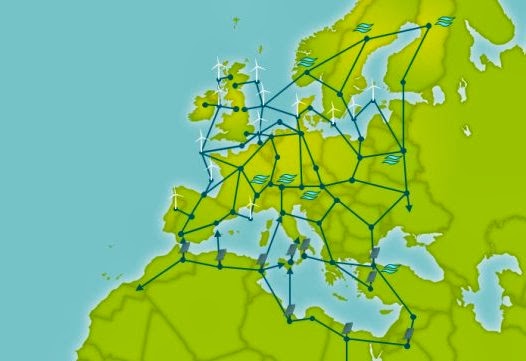
-- a _kt75 | reprint European Union governments and the bloc’s executive arm are splitting over how to guarantee electricity supply as the region builds more renewable power. Germany, France and the U.K. are following nations from Spain to Greece in developing programs called capacity mechanisms to pay utilities to keep plants on standby from as early as 2016. The European Commission instead plans a single market by the end of the year. Supply and demand in 15 markets was for the first time linked today through a daily auction. Europe’s power market relied on intermittent wind and solar output for a record 7.4 percent of generation in 2012, a share poised to reach 18 percent by 2020, according to Energy Brainpool GmbH & Co. KG., a Berlin-based consultant. The renewable energy boom cut profitable hours at coal and gas-fired plants and IHS Inc. estimates that as much as 60 percent of the region’s gas capacity isn’t covering costs and may be a...

Call for Abstracts: Quarterly Notes on Sustainable Water Management
Q01/2014

Image
-- a _kt75 | note Download the Quarterly Notes on Sustainable Water Management - Q04/2013 Submit your Abstract for the next issue of the Quarterly Notes NEW : Preview the Notes The next issue of the Quarterly Notes on Sustainable Water Management will be released early April 2014. The original content structure of the notes  Technology,  Research,  Politics&Society will be completed by the new section Energy As previously, abstracts of newly published - but also not yet published - articles addressing the above sections and concentrating on water management and related topics are welcomed. The contributions should range in the order of 200-400 words (in exceptions and if acceptable larger contributions are accepted as well), they must be written in English (well formulated) and they must be provided along with the complete references. Submit your contribution until 29th February 2014 , either as .doc, .docx, .rtf, or .txt-document t...

Business Perspectives: Sustainability is always a Question of Growth

Image
► NEW : see all _kt75 | articles at a glance in the _news database -- a _kt75 | reprint   Tweet Business activity lives within the context of the social and natural environment, and the economic sustainability of business depends on social and environmental sustainability is a graphic that helps to illustrate how business activity belongs to a larger context called society and how both business and society are a part of the larger system of nature on this planet. Business management today is accountable for social and environmental, as well as financial results. Business activity lives within the context of the social and natural environment, and the economic sustainability of business depends on social and environmental sustainability is a graphic that helps to illustrate how business activity belongs to a larger context called society and how both business and society are a part of the larger system of nature on this planet. Business management tod...

Let's talk about S...ustainability?
OECD Environmental Outlook 2050

Image
-- a _kt75 | reprint Tweet Around the world, cities, farmers, industries, energy suppliers, and ecosystems are increasingly competing for their daily water needs. Without proper water management, the costs of this situation can be high – not just financially, but also in terms of lost opportunities, compromised health and environmental damage. Without major policy changes and considerable improvements in water management, by 2050 the situation is likely to deteriorate, increasing uncertainty about water availability. This chapter summarises the key pressures on water, as well as the main policy responses. It starts by looking at current water challenges and trends and how they could affect the water outlook in 2050. It considers competing demands for water (from agriculture/irrigation, industry, electricity, domestic/urban supply, environment flows) and over-exploitation (both surface and groundwater), water stress, water-related disasters (e.g. floods), water po...

Back in Black: Fossil Fuels the Energy Carriers of the Future?

Image
-- a _kt75 | reprint supporting information: [ 1 ], [ 2 ], [ 3 ], [ 4 ], [ 5 ]   Tweet The global energy map is changing, with potentially far-reaching consequences for energy markets and trade. It is being redrawn by the resurgence in oil and gas production in the United States and could be further reshaped by a retreat from nuclear power in some countries, continued rapid growth in the use of wind and solar technologies and by the global spread of unconventional gas production. Perspectives for international oil markets hinge on Iraq’s success in revitalising its oil sector. If new policy initiatives are broadened and implemented in a concerted effort to improve global energy efficiency, this could likewise be a game-changer. On the basis of global scenarios and multiple case studies, this World Energy Outlook assesses how these new developments might affect global energy and climate trends over the coming decades. It examines their impact on the critical c...

Master of Disaster?
Imagine... Nuclear Power proves to be a Sustainable Energy Source

Image
-- a _kt75 | reprint compilation   Tweet Intro Nuclear Power? Today considered risky, dirty, dangerous - in other words: nuclear power per se cannot be considered sustainable. But imagine the following scenery: i) the danger of nuclear accidents is minimised and if an accident happens, the consequences can be handled in a reasonable way; ii) the issue of nuclear waste is solved, i.e. life cycle of the raw materials (uranium) is closed. - Would, under the above conditions, nuclear power still be considered a non-sustainable energy alternative? A number of articles reflected on this topic and come to the following conclusions: Paper 1 : Nuclear Power is the most practical, sustainable, and environmentally friendly energy generation option available to the United States in the near future. It is “green,”—it does not endanger the environment. It is sustainable—enough fuel to meet U.S. needs for well over a hundred years is readily available. With further te...

Black or White? Why Germany's 'Energy Turnaround' needs Reconsideration

Image
-- a _kt75 | reprint     Tweet The cornerstones of Germany's energy turn-around can be admired in a hall in the northern port city of Bremerhaven. Standing on three rust-brown feet apiece, each of these immense, yellow-painted trunks weighs as much as 900 elephants. Soon, special ships will come and sink these steel monsters into the seabed, where they will support the wind turbines that are supposed to supply the country with green electricity. Before they do, Environment Minister Peter Altmaier will go to Bremerhaven to inspect the work of Weser Wind and Areva Wind, the companies building them. Areva calls these wind-turbine supports "tripods." Peter Altmeier has a more poetic term, dubbing them "cathedrals to industrial culture." This last week, there was a strict division of labor at several locations around the country. From Monday to Wednesday, the environment minister went on a whirlwind tour of Germa...

Renewable Energy's Hidden Costs?

Image
-- a _kt75 | reprint    A recent Bloomberg press release got wide coverage with its claim that wind power is now cheaper than coal. But a new report from the OECD shows that when you cover the full cost to the grid, variable renewables like wind don’t add up as favourably. It is often claimed that introducing variable renewable energy resources such as solar and wind into the electricity network comes with some extra cost penalties, due to “system effects”. These system effects include intermittent electricity access, network congestion, instability, environmental impacts, and security of supply. Now a new report from the OECD titled System Effects of Low-Carbon Electricity Systems gives some hard dollar values for these additional imposts. The OECD work focuses on nuclear power, coal, gas, and renewables such as wind and solar. Their conclusion is that grid-level system costs can have significant impacts on the tota...

Tar Sands - their nature, their importance, their effects: Outlook 2030

Image
-- a _kt75 | post    Oil sands (also named: tar sands or, more technically, bituminous sands ) are a kind of unconventional petroleum deposit, i.e. represent fossil energy deposits. From the ir structure oil sands form a loose sand or partially consolidated sandstone containing naturally occurring compositions of sand , clay , and water, saturated with a dense and extremely viscous form of petroleum technically referred to as bitumen (or colloquially tar due to its similar appearance, odour and colour) . Oil s ands have been exploited since Paleolithic times but the modern in dustrial (i.e. commercial) mining of this type of fossil fuel deposits has begun in the 1 920ies [ 1 ]. Since that time the mining has contin uously risen and has exper ienced a dramatic incr ease in the most recent years [ 2 ] , [ 3 ]. Acco rdingly, today the total production v olume of tar sands amounts to about 1.9 million barrel per day [ 4 ] and is estimated to conti nue to r i...