Posts

Showing posts with the label jordan

Hot Spot II: Importing Drinking Water
Experiences from the US, South Africa and Australia

Image
-- a _kt75 | reprint _NEW: explore all _kt75 | publications via the news db... and leave your comments here Of all the clean water that our cities consume, roughly half of it flows down our sewers to sewage treatment plants where it is treated and released back to the environment. Conventional sewage treatment plants are designed to clean this water to a degree that can be discharged to rivers or the ocean without major environmental or public health impacts. In many parts of the world, sufficient fresh water supplies are increasingly difficult to source. Water stressed cities now import water, pumped over large distances at a considerable energy cost. Los Angeles, for example, imports 8.9bn litres of water a day to meet the city’s needs. Other cities, such as Ashkelon in Israel, are investing in seawater desalination to produce drinkable water. But this process is also highly energy intensive and its application limited to coastal locations. An al...

Shared Water Resources in Western Asia: an Inventory Approach

Image
-- a _kt75 | reprint NEW: explore all _kt75 | publications via the news db... and leave your comments here The sharing of water resources has been an influential feature affecting life, society and development in the Arabian Peninsula , the Mashrek and Mesopotamia for millennia. Historically, communities living in these arid and semi-arid regions always shared the water of rivers, springs and wadis, although this was more out of necessity than idealism. Water resources were traditionally managed at the local level, with tensions emerging between Bedouins, shepherds, pastoralists and growing urban centres. Water management and irrigation schemes – such as the underground aqueducts or falaj networks found in Bahrain, Oman, Saudi Arabia and Yemen – sustained different communal needs for dozens of centuries, while the marshes of Mesopotamia, the Tigris floodplain and the Jordan River Valley were cultivated and sustained successive civilizations since earliest of times. Hills...

The Iranian Water Crisis: A Strategic Analysis

Image
-- a _kt75 | reprint Download: Quarterly Notes on Sustainable Water Management - Q02/2014 . Abstract In 2013 faced with a critical shortage of water, the Iranian government called for water conservation and greater water use efficiency nation-wide. Despite imminent shortages , water use in Iran remains inefficient, with domestic use 70 per cent higher than the global average. Iran has a national population of 75 million people, 12 million of whom reside in the capital; demand for water is rapidly increasing, even as major lakes and groundwater resources begin to shrink. Population growth, more frequent droughts and the effects of climate change are creating the ‘perfect storm’ for future water insecurity. We are left with the question, are the proposed changes too little, too late? Paper (abbrev.) Security in the Middle East continues to focus on the political and geostrategic priorities of regional states, but a greater challenge has now presented itself, in the for...

Quarterly Notes on Sustainable Water Management - Q02/2014

Image
-- a _kt75 | note Download: Quarterly Notes on Sustainable Water Management - Q02/2014 . The most recent issue of the Quarterly Notes on Sustainable Water Management (Q02/2014) is freely available. In continuation of the successful publication of the Quarterly Notes on Sustainable Water Management the current issue concentrates on a broad range of topics including land subsidence, implications of climate change on ground water regimes, technical developments in the small hydro power sector, etc. Geographically, the Notes once more focus on regions exposed to complicated water supply conditions: Middle-East and Asia. A number of publications tackle the named issues in detail and provide cutting-edge insights on present developments. An important, because seldom considered, region represents the Horn of Africa and the water supply issues encountered there. A comprehensive overview is provided by a dedicated report. As always all reprints are completely refere...

Quarterly Notes on Sustainable Water Management - Q01/2014

Image
-- a _kt75 | note Download: Quarterly Notes on Sustainable Water Management - Q01/2014 . The most recent issue of the Quarterly Notes on Sustainable Water Management (Q01/2014) is freely available. This release of the Notes comes along with a substantial diversification in terms of content. As with this issue the section 'Energy' is inserted immediately after the section 'Technology'. By this, it is intended to emphasise and consider the importance of water as an important energy carrier. Thematically, this issue concentrates on two highly sensitive issues affecting sustainable water management: the extraction of natural gas and crude oil by measn of hydraulic fracking on the one hand and the accounting of virtual water (especially with regarding to trading and agriculture) on the other hand. Both topics pose severe challenges. Whereas the former is often criticised to affect the natural water balance, in particular the mechanisms of the groun...

Release Announcement: _sustinvent+ v0.605 RC1 | single window version
Hydro Power Data Base

Image
-- a _kt75 | note ■ Explore       _sust invent + v0.605 RC1 | single window ■ Download      White Paper ■ See           Promo Clip    Tweet As of today the newest version of _sust invent + v0.605 RC1 | single window version is available online. In total this version comprises inventories of hydro power facilities of Africa, Middle-East and China, incl . : ■ Jordan ■ Syria ■ Saudi Arabia ■ Yemen ■ China ■ South Africa ■ Angola ■ Ethiopia ■ Lebanon ■ Libya ■ Algeria ■ Burkina Faso ■ Namibia ■ ... The online version of _sust invent + v0.605 RC1 provides you access to the following countries: ■ Angola , Cameroon, Ethiopia, Iraq, and Jordan To get the full version of _sust invent + v0.605 RC1 send a request to:  kt75@gmx.ch     Summary Sustainable water management represents one of the key challenges towards future-proof de...

Quarterly Notes on Sustainable Water Management - Q04/2013

Image
-- a _kt75 | note     ▶ _download the Quarterly Notes on Sustainable Water Management here: server 1 ( wrong link, corrected 2013-12-16 )   Tweet ■ _sust invent + v0.605 RC1 ■ Jordan’s Water Resource Challenges ■ Intelligent Metering for Urban Water ■ Innovative Mine Water Treatment in Post-Mining Areas ■ Hydro Power in Turkey ■ Spatial Analysis of Impacts of Hydro Power Dam ■ Effect of Mining on Geochemistry ■ Assessment of hydro geochemical characteristics ■ Impacts of Coal Mining on Groundwater Environment ■ Clear Gold Water as a Strategic Resource in Middle-East ■ Blue Peace: The Way forward in the Middle-East ■ Jordan’s Path to Water Security ■ Changing Ownership Structures in the Water Supply and Sanitation Sector ■ … After more than half a year of thorough, comprehensive and in-depth analysis of global hydro power data the next release of the _sustinvent+ data base (version 0.605 RC1) can be announced. The data base now includes ...

Jordan’s Water Resources: Challenges for the Future

Image
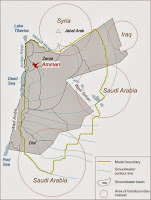
► NEW : see all _kt75 | articles at a glance in the _news database   -- a _kt75 | reprint     Tweet _progress | M replaces _kt75 | mirror. visit: http://progress-m.blogspot.com . ready: 01.07.2015. close ✕ This paper reviews the status of the water resources in the Hashemite Kingdom of Jordan in the context of the global pattern of increasing demand for water linked to population increase, a growing urban-based population and increasing economic progress. Jordan is currently one of the world‟s ten water poorest nations, a situation which is being exacerbated by a rapidly growing population. Jordan has a climate ranging from Mediterranean to Arid with approximately 80 per cent of the country receiving less than 100mm of precipitation annually. Evaporation ranges from around 2000mm per year in Zarqa in the north west of the country to over 5000mm per year in Ma‟an in the south. Renewable freshwater resources are of the order of 750-850 million cubic met...