Posts

Showing posts with the label costs

Renewables - Part I: Is Solar Energy Ready To Compete With Oil And Other Fossil Fuels?
- a status note -

Image
reprint The solar energy industry may prove to be a dark horse in the race to provide global energy security. The world has renewed its interest in solar energy investment as it searches for a cleaner and more sustainable alternative to conventional fossil fuels. Countries like China , Germany, the UK, the US, Japan and Canada have already made significant investments in solar power . Who are the other players who are investing big in solar energy? With its own set of limitations such as high installation costs and high plug-in time, are consumers across the world ready to choose solar energy to power their daily lives? Or, are the conventional energy sources still the best bet? The best part about solar energy is that it is abundant and freely available, at least in most parts of the world. However, the high upfront costs of a photo voltaic panel remain a concern for many. Things are changing fast, however, and according to data from SEIA, the cost of an average PV system i...

German economy vulnerable to global water scarcity

Image
-- a _kt75 | reprint NEW: explore all _kt75 | publications via the news db... Water is scarce but it continues to be wasted excessively in many industrial states, warns a new study by the World Wide Fund for Nature (WWF), predicting that a global conflict over water resources could bring billions in losses for the German market. EurActiv Germany reports.  Tomatoes from Spain, textiles from India, metals from South Africa, roses from Kenya; every year, Germany imports massive amounts of goods from around the world that would not be available without considerable water resources. But water is becoming an increasingly scarce global resource . In many countries, it has become more and more difficult to supply the population with adequate drinking water and irrigation for crops. Besides export-reliant countries with critical water resources, the effects of the shortage can be devastating for others as well. According to the World Wide Fund for Nature ...

Up!
EU: The Price of Water on the Rise/CH: Wasser wird teurer...

Image
-- a _kt75 | double reprint: EN/DE Download: Quarterly Notes on Sustainable Water Management - Q02/2014 . The environmental resources situation is shaped by changes in climatic conditions, coupled with pressures exerted by a rapidly growing global population, its increasing demands and the subsequent impacts on the environment. Current practices across the economy sectors are still not sufficiently ambitious in terms of sustainability ; they fail to ameliorate the stress conditions of vital resources like water. In recent years, the need has been highlighted for governance and management schemes that allocate resources appropriately among users (including the environment) and that promote the efficient use of such resources. The very nature of these needs calls for adequate policy responses. One of these policy responses — applied either separately or in combination with other economic or regulatory instruments — is water pricing . The use of such instruments brings a...

Business Perspectives: Sustainability is always a Question of Growth

Image
► NEW : see all _kt75 | articles at a glance in the _news database -- a _kt75 | reprint   Tweet Business activity lives within the context of the social and natural environment, and the economic sustainability of business depends on social and environmental sustainability is a graphic that helps to illustrate how business activity belongs to a larger context called society and how both business and society are a part of the larger system of nature on this planet. Business management today is accountable for social and environmental, as well as financial results. Business activity lives within the context of the social and natural environment, and the economic sustainability of business depends on social and environmental sustainability is a graphic that helps to illustrate how business activity belongs to a larger context called society and how both business and society are a part of the larger system of nature on this planet. Business management tod...

Moneytalks: ... on the Economic Aspects of Water Dams

Image
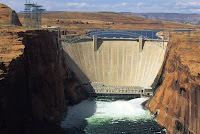
-- a _kt75 | reprint compilation   Tweet Reprint: Large dams have long been promoted as providing "cheap" hydropower and water supply. Today, we know better. The  costs and poor performance of large dams were in the past largely concealed by the public agencies that built and operated the projects. Dams consistently cost more and take longer to build than projected. In general, the larger a hydro project is, the larger its construction cost overrun in percentage terms. The true risks and costs of dams are being forced into the open due to increasing public scrutiny and attempts to attract private investors to existing and new projects. The World Commission on Dams found that on average, large dams have been at best only marginally economically viable. The average cost overrun of dams is 56%. This means that when a dam is predicted to cost $1 billion, it ends up costing $1.56 billion. In too many cases, the burden of uneconomic dams is...

Renewable Energy's Hidden Costs?

Image
-- a _kt75 | reprint    A recent Bloomberg press release got wide coverage with its claim that wind power is now cheaper than coal. But a new report from the OECD shows that when you cover the full cost to the grid, variable renewables like wind don’t add up as favourably. It is often claimed that introducing variable renewable energy resources such as solar and wind into the electricity network comes with some extra cost penalties, due to “system effects”. These system effects include intermittent electricity access, network congestion, instability, environmental impacts, and security of supply. Now a new report from the OECD titled System Effects of Low-Carbon Electricity Systems gives some hard dollar values for these additional imposts. The OECD work focuses on nuclear power, coal, gas, and renewables such as wind and solar. Their conclusion is that grid-level system costs can have significant impacts on the tota...

Tar Sands - their nature, their importance, their effects: Outlook 2030

Image
-- a _kt75 | post    Oil sands (also named: tar sands or, more technically, bituminous sands ) are a kind of unconventional petroleum deposit, i.e. represent fossil energy deposits. From the ir structure oil sands form a loose sand or partially consolidated sandstone containing naturally occurring compositions of sand , clay , and water, saturated with a dense and extremely viscous form of petroleum technically referred to as bitumen (or colloquially tar due to its similar appearance, odour and colour) . Oil s ands have been exploited since Paleolithic times but the modern in dustrial (i.e. commercial) mining of this type of fossil fuel deposits has begun in the 1 920ies [ 1 ]. Since that time the mining has contin uously risen and has exper ienced a dramatic incr ease in the most recent years [ 2 ] , [ 3 ]. Acco rdingly, today the total production v olume of tar sands amounts to about 1.9 million barrel per day [ 4 ] and is estimated to conti nue to r i...

Hydro Power: a sustainable but sensitive Energy Alternative

Image
-- a note from _kt75 Hydro power is considered one of the promising sustainable (because renewable) ener g y sources able to fa cilitate and guarantee a safe energy turnaround away from fossil energy carriers. Accordingly, hydro power industry is on the rise a nd a multitude of construction projects are either in the planning stage , in progress or already finished. However, as in any other case in ad dition to the te chnical dimension al so hydr o power has a n e nvironmental , an economic and a geo-p olitical d imen sion which are cl osely interlinked [ 1 ]. Due to the ongoing pronounced and rather uni -directional prom otion of al ternative/renewable en ergy car riers (like hydro power ) critical tra de-offs and ass oci ated conflicts (whatever kind of) can create rat her drastic situations and the actually sustainable nature of renewable energy carr iers gets lost. In particular politically unstable, mainly developing regions are concerned [ 2 ] - [ 5 ] . Here, bu...