Posts

Showing posts with the label sustainable development

Construction Time Again: the Return of Nuclear Power

Image
_NEW: follow the development of the new web-presence wolframscharnhorst.blogspot.com reprint East–West nuclear rivalry is back. The Ukraine crisis threatens the nuclear governance . Demand for nuclear energy is growing again after the 2011 Fukushima disaster. A 2014 report by Bloomberg New Energy Finance forecasts a 69 per cent expansion in nuclear capacity worldwide from 345GW in 2012 to 583GW by 2030. Furthermore, the International Energy Agency counts that more than three-quarters of nuclear reactors under construction are in non-OECD (Organisation for Economic Co-operation and Development) countries. China’s domestic appetite for energy accounts for much of this increase, with four to six reactors expected to be built every year for the next five years. Civil nuclear facilities in China incorporate technology from a variety of western suppliers, but Beijing has aggressively negotiated for intellectual property to be shared during the acqui...

_smoke on the Water: Freshwater Shortage Will Double Climate
Change’s Impact on Agriculture (Study)

Image
-- a _kt75 | reprint _NEW: explore all _kt75 | publications via the news db... and leave your comments here _Experts expect global warming to have a negative impact on crop yields, but shortages of water for irrigation could make for double the trouble, according to a study published yesterday. As described in ScienceDaily, “given the present trajectory of greenhouse gas emissions, agricultural models estimate that climate change will directly reduce food production from maize, soybeans, wheat and rice by as much as 43 percent by the end of the 21st century. But hydrological models looking at the effect of warming climate on freshwater supplies project further agricultural losses, due to the reversion of 20 to 60 million hectares of currently irrigated fields back to rain-fed crops.” The study’s lead author, Joshua Elliot, said the analysis is the first of its kind to feature an in-depth comparison of agricultural and hydrological models, which...

Hot Spot I: China's Water Scarcity is Virtual

Image
-- a _kt75 | reprint NEW: explore all _kt75 | publications via the news db... and leave your comments here Water footprints and virtual water flows have been promoted as important indicators to characterize human-induced water consumption. However, environmental impacts associated with water consumption are largely neglected in these analyses. Incorporating water scarcity into water consumption allows better understanding of what is causing water scarcity and which regions are suffering from it. _progress | M replaces _kt75 | mirror. visit: http://progress-m.blogspot.com . ready: 01.07.2015. close ✕ In this study, we incorporate water scarcity and ecosystem impacts into multiregional input-output analysis to assess virtual water flows and associated impacts among 30 provinces in China. China, in particular its water-scarce regions , are facing a serious water crisis driven by rapid economic growth. Our findings show that inter-regional flows of virtual water rev...

_silenced
Setbacks in Sustainability Communication.

Image
-- a _kt75 | note NEW: explore all _kt75 | publications via the news db... This is the two hundredth _kt75 | post since February 2010 and with a daily hit rate between 100 and 200 unique visitors the _kt75 | mirror appears to be a well-accepted source of information in a rather narrow niche: sustainable development with a focus on water management . However, even reliable entities like the _kt75 | mirror seem to be subject to some kind of censor-ship. Just recently the LinkedIN channel of the _kt75 | mirror was temporarily shut-down because of the following baseless accusations: phishing multiple contacting spamming Phishing was never done via _kt75 | mirror, neither multiple contacting. Remains 'spamming'. Now, it might be worth to clarify that the _kt75 | mirror is operated without any kind of (3rd party) advertisement. The only service _kt75 | mirror offers (free of charge) is information supply. This effort is performed with highest dedication and ac...

Moneytalks II: World needs $48 trillion in investment to meet its energy needs to 2035

Image
-- a _kt75 | reprint Download: Quarterly Notes on Sustainable Water Management - Q01/2014 IEA World Energy Outlook special report sees rising role of governments in shaping investment decisions. Meeting the world’s growing need for energy will require more than $48 trillion in investment over the period to 2035, according to a special report on investment released today by the International Energy Agency (IEA) as part of the World Energy Outlook series. Today’s annual investment in energy supply of $1.6 trillion needs to rise steadily over the coming decades towards $2 trillion. Annual spending on energy efficiency, measured against a 2012 baseline, needs to rise from $130 billion today to more than $550 billion by 2035. “The reliability and sustainability of our future energy system depends on investment,” said IEA Executive Director Maria van der Hoeven. “But this won’t materialise unless there are credible policy frameworks in place ...

To be or not to be ...
Sustainability a question of supply and demand?

Image
-- a _kt75 | reprint Inside Sustainability: Facts, Figures, Bullshit - Part II: Alternative Energy Global demand for energy is inexhaustible. In developed countries, populations continue to rise putting pressure on water, sanitation and other requirements. A growing taste for comfort and convenience demands air conditioning and heating systems, transport solutions, entertainment activities and a range of other related energy-hungry luxuries. The less developed world is also becoming more sophisticated and more populous and demand is growing from the BRIC nations, South Africa and other areas to place even more pressure on natural resources. Renewables such as solar, wind and tidal options present an alternative to traditional fossil energies, but these are expensive and still largely in their infancy. This means the world must continue to look to oil and gas for the immediate solution. Existing oil fields in the more accessible regions are now mature, so ...

Controversial: Asian Giants Look to the Arctic

Image
-- a _kt75 | reprint Quarterly Notes on Sustainable Water Management - Q04/2013 Inside Sustainability: Facts, Figures, Bullshit - Part II: Alternative Energy India and China are in a race to build a presence in the energy-rich Arctic region. After a lengthy courtship, China and India formalized their relationship with the Arctic Council in May 2013 by gaining admission as official observer states. In the months since, both countries have been actively seeking influence with the Council’s permanent members to further establish footholds in a region certain to emerge as a central arena of 21st century geopolitics, scientific research and commerce. But while public statements out of Beijing and New Delhi since May have often cited climate change research as the primary driver of the two countries’ Arctic engagement, the real underlying motive remains securing access to the region’s greatest natural treasure: energy. In recent years, the U.S. Geological Surve...

Supply Security as Renewable Energy Grows: European Disagreements

Image
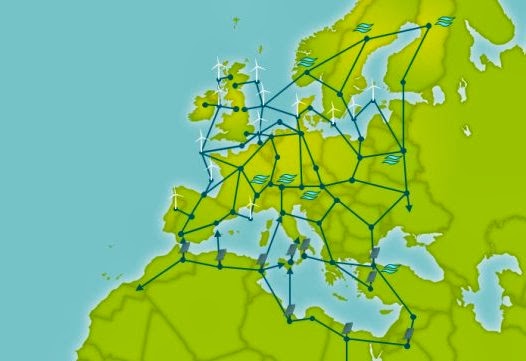
-- a _kt75 | reprint European Union governments and the bloc’s executive arm are splitting over how to guarantee electricity supply as the region builds more renewable power. Germany, France and the U.K. are following nations from Spain to Greece in developing programs called capacity mechanisms to pay utilities to keep plants on standby from as early as 2016. The European Commission instead plans a single market by the end of the year. Supply and demand in 15 markets was for the first time linked today through a daily auction. Europe’s power market relied on intermittent wind and solar output for a record 7.4 percent of generation in 2012, a share poised to reach 18 percent by 2020, according to Energy Brainpool GmbH & Co. KG., a Berlin-based consultant. The renewable energy boom cut profitable hours at coal and gas-fired plants and IHS Inc. estimates that as much as 60 percent of the region’s gas capacity isn’t covering costs and may be a...

A Rare Middle East Agreement, on Water

Image
-- a _kt75 | reprint Download the Quarterly Notes on Sustainable Water Management - Q04/2013   In a rare display of regional cooperation, representatives of Israel, Jordan and the Palestinian Authority signed an agreement on Monday to build a Red Sea-Dead Sea water project that is meant to benefit all three parties.   The project addresses two problems: the acute shortage of clean fresh water in the region, especially in Jordan, and the rapid contraction of the Dead Sea. A new desalination plant is to be built in Aqaba, Jordan, to convert salt water from the Red Sea into fresh water for use in southern Israel and southern Jordan — each would get eight billion to 13 billion gallons a year. The process produces about the same amount of brine as a waste product; the brine would be piped more than 100 miles to help replenish the already very saline Dead Sea. Under the agreement, Israel will also provide Amman, the Jordanian capital, with ...

Critical situation: global water shortages may pose threat of terror and war

Image
-- a _kt75 | reprint Download the Quarterly Notes on Sustainable Water Management - Q04/2013   From California to the Middle East, huge areas of the world are drying up and a billion people have no access to safe drinking water. US intelligence is warning of the dangers of shrinking resources and experts say the world is 'standing on a precipice' On 17 January, scientists downloaded fresh data from a pair of Nasa satellites and distributed the findings among the small group of researchers who track the world's water reserves. At the University of California, Irvine, hydrologist James Famiglietti looked over the data from the gravity-sensing Grace satellites with a rising sense of dread. The data, released last week, showed California on the verge of an epic drought, with its backup systems of groundwater reserves so run down that the losses could be picked up by satellites orbiting 400km above the Earth's surface. "It was defin...

Pump up the Volume -
The Economic Trade-offs of Large Water Dams in South-East Asia

Image
-- a _kt75 | reprint     Tweet Over the last two decades, Chinese governments have approved the construction of a cascade of large dams on the stretches of the Mekong River that lie within its borders, prompting disquiet amongst downstream riparian states . Those states — Cambodia, Laos, Thailand and Vietnam — are now set to wage their own battle for control of precious water resources, with China looming large through its role as a willing creditor. Despite hydropower plans for the Lower Mekong dating back to the 1950s, the river still flows freely south of the Chinese border. That may not be the case for much longer. The governments of Cambodia, Laos, Thailand and Vietnam have proposed to build eleven dams on the Lower Mekong — nine in Laos and two in Cambodia. Much of the electricity generated would ultimately be consumed in Thailand and Vietnam through contract agreements between the four states. The first of these proposed dam...

Highway to Hell? Mobility Perspectives World-Wide

Image
-- a _kt75 | reprint   Tweet There is not a single future of mobility. Transport will vary according to settlement size, geography, culture and the existing infrastructure and services that will evolve to provide future mobility. There tends to be a future view of mobility that centres around high-rise megacities and high-tech transport systems - hover cars, jet packs, railroads in the sky. This view has remained the same for almost a century - but I believe the future is oversold and under-imagined. The world's population is growing and becoming more urban. There are currently seven billion people living on the planet, with just over half in urban areas - but beware the word urban, it has no single definition and can refer to quite small settlements. Only 5% of the world's population live in megacities (using the UN definition of more than 10 million people). In Europe, two thirds of the urban population live in settlements of fewer than...

Good News:
Stable Energy Supply is a Challenge... it can be solved // Diversification & Integration

Image
-- a _kt75 | reprint   Tweet In the IEO2013 Reference case, world energy consumption increases from 524 quadrillion Btu in 2010 to 630 quadrillion Btu in 2020 and 820 quadrillion Btu in 2040, a 30-year increase of 56 percent. More than 85 percent of the increase in global energy demand from 2010 to 2040 occurs among the developing nations outside the Organization for Economic Cooperation and Development (non-OECD), driven by strong economic growth and expanding populations. In contrast, OECD member countries are, for the most part, already more mature energy consumers, with slower anticipated economic growth and little or no anticipated population growth. Many economic and geopolitical circumstances add considerable uncertainty to any long-term assessment of world energy markets. Currently, there is wide variation in the economic performance of different countries and regions around the world. Among the more mature OECD reg...

Back in Black: Fossil Fuels the Energy Carriers of the Future?

Image
-- a _kt75 | reprint supporting information: [ 1 ], [ 2 ], [ 3 ], [ 4 ], [ 5 ]   Tweet The global energy map is changing, with potentially far-reaching consequences for energy markets and trade. It is being redrawn by the resurgence in oil and gas production in the United States and could be further reshaped by a retreat from nuclear power in some countries, continued rapid growth in the use of wind and solar technologies and by the global spread of unconventional gas production. Perspectives for international oil markets hinge on Iraq’s success in revitalising its oil sector. If new policy initiatives are broadened and implemented in a concerted effort to improve global energy efficiency, this could likewise be a game-changer. On the basis of global scenarios and multiple case studies, this World Energy Outlook assesses how these new developments might affect global energy and climate trends over the coming decades. It examines their impact on the critical c...

Master of Disaster?
Imagine... Nuclear Power proves to be a Sustainable Energy Source

Image
-- a _kt75 | reprint compilation   Tweet Intro Nuclear Power? Today considered risky, dirty, dangerous - in other words: nuclear power per se cannot be considered sustainable. But imagine the following scenery: i) the danger of nuclear accidents is minimised and if an accident happens, the consequences can be handled in a reasonable way; ii) the issue of nuclear waste is solved, i.e. life cycle of the raw materials (uranium) is closed. - Would, under the above conditions, nuclear power still be considered a non-sustainable energy alternative? A number of articles reflected on this topic and come to the following conclusions: Paper 1 : Nuclear Power is the most practical, sustainable, and environmentally friendly energy generation option available to the United States in the near future. It is “green,”—it does not endanger the environment. It is sustainable—enough fuel to meet U.S. needs for well over a hundred years is readily available. With further te...

Moneytalks: ... on the Economic Aspects of Water Dams

Image
-- a _kt75 | reprint compilation   Tweet Reprint: Large dams have long been promoted as providing "cheap" hydropower and water supply. Today, we know better. The  costs and poor performance of large dams were in the past largely concealed by the public agencies that built and operated the projects. Dams consistently cost more and take longer to build than projected. In general, the larger a hydro project is, the larger its construction cost overrun in percentage terms. The true risks and costs of dams are being forced into the open due to increasing public scrutiny and attempts to attract private investors to existing and new projects. The World Commission on Dams found that on average, large dams have been at best only marginally economically viable. The average cost overrun of dams is 56%. This means that when a dam is predicted to cost $1 billion, it ends up costing $1.56 billion. In too many cases, the burden of uneconomic dams is...