Posts

Showing posts with the label middle east asia

Hotspot III: 60 percent of the Middle-East wastewater is discharged to Sea
(report)

Image
-- a _kt75 | reprint _NEW: explore all _kt75 | publications via the news db... and leave your comments here Approximately 40 to 60 percent of the region’s waste water is discharged into the sea when it could be stored and reused for other purposes, according to ARCADIS’ 2014 Middle East Aquifer Recharge report.“The region should use treated sewage effluent (TSE) as the precious resource it is and stop thinking of it as waste or a useless by-product,” said Titia De Mes, Water for Industry Leader, Middle East at ARCADIS. “TSE can and should be recycled, but this requires a change in thinking from being a choice and a cost to a necessity and investment – the optimal choice for the Middle East is aquifer recharge and recovery.” The report reveals that merely 60 percent of TSE could be stored in the aquifer and used at a later time through various approaches, highlighting three different methods to aquifer recharge – aquifer storage and recovery; aquifer sto...

The Iranian Water Crisis: A Strategic Analysis

Image
-- a _kt75 | reprint Download: Quarterly Notes on Sustainable Water Management - Q02/2014 . Abstract In 2013 faced with a critical shortage of water, the Iranian government called for water conservation and greater water use efficiency nation-wide. Despite imminent shortages , water use in Iran remains inefficient, with domestic use 70 per cent higher than the global average. Iran has a national population of 75 million people, 12 million of whom reside in the capital; demand for water is rapidly increasing, even as major lakes and groundwater resources begin to shrink. Population growth, more frequent droughts and the effects of climate change are creating the ‘perfect storm’ for future water insecurity. We are left with the question, are the proposed changes too little, too late? Paper (abbrev.) Security in the Middle East continues to focus on the political and geostrategic priorities of regional states, but a greater challenge has now presented itself, in the for...

Fracking: Should India Dive into the Shale Boom?

Image
-- a _kt75 | reprint Download: Quarterly Notes on Sustainable Water Management - Q01/2014 The energy economics of the world is now at a crossroads, giving rise to a fiery debate among experts whether it will bring about a momentous change in the world’s strategic balance. The Ukraine crisis has given an impetus to it by threatening a cut in the supply of Russian oil and gas to Europe; the West is now on the lookout for an alternative source of energy. With the United States making rapid progress in the area of shale oil and gas technology, and several large-scale shale reserves being discovered in Western Europe and Latin America, dependence on hydrocarbon supplies from the Middle East and the Persian Gulf will decrease, which will ultimately lead to a lapse in big power involvement in the region. This has all come as a boon to American companies involved in the exploitation of shale resources, and they are leaving no stone unturned in sweeping away the impediment...

Controversial 3
Solar sector faces uncertain future in China

Image
-- a _kt75 | reprint Inside Sustainability: Facts, Figures, Bullshit - Part II: Alternative Energy China's solar energy sector is a tale of two industries, in which ailing, overcapacity-plagued panel, parts and materials manufacturers are shunned by banks, while downstream solar farm developers boast mind-blowing expansion plans and credit lines. But behind the multibillion-yuan construction plans and loan agreements with banks lie concerns that the solar farm building binge will see a repeat of the growing pains and low returns suffered by wind farm developers in 2011 and 2012 due to the inability of power grids to absorb much of their output. "Risks abound, some of these developers have been telling investors that their projects have no problems connecting with the grids, but they have yet to give convincing evidence to support their assertion," said CIMB Securities utilities and renewable energy analyst Keith Li. Shunfeng Photovoltaic International,...

Quarterly Notes on Sustainable Water Management - Q04/2013

Image
-- a _kt75 | note     ▶ _download the Quarterly Notes on Sustainable Water Management here: server 1 ( wrong link, corrected 2013-12-16 )   Tweet ■ _sust invent + v0.605 RC1 ■ Jordan’s Water Resource Challenges ■ Intelligent Metering for Urban Water ■ Innovative Mine Water Treatment in Post-Mining Areas ■ Hydro Power in Turkey ■ Spatial Analysis of Impacts of Hydro Power Dam ■ Effect of Mining on Geochemistry ■ Assessment of hydro geochemical characteristics ■ Impacts of Coal Mining on Groundwater Environment ■ Clear Gold Water as a Strategic Resource in Middle-East ■ Blue Peace: The Way forward in the Middle-East ■ Jordan’s Path to Water Security ■ Changing Ownership Structures in the Water Supply and Sanitation Sector ■ … After more than half a year of thorough, comprehensive and in-depth analysis of global hydro power data the next release of the _sustinvent+ data base (version 0.605 RC1) can be announced. The data base now includes ...

Jordan’s Water Resources: Challenges for the Future

Image
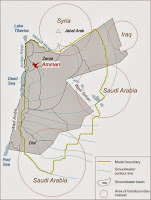
► NEW : see all _kt75 | articles at a glance in the _news database   -- a _kt75 | reprint     Tweet _progress | M replaces _kt75 | mirror. visit: http://progress-m.blogspot.com . ready: 01.07.2015. close ✕ This paper reviews the status of the water resources in the Hashemite Kingdom of Jordan in the context of the global pattern of increasing demand for water linked to population increase, a growing urban-based population and increasing economic progress. Jordan is currently one of the world‟s ten water poorest nations, a situation which is being exacerbated by a rapidly growing population. Jordan has a climate ranging from Mediterranean to Arid with approximately 80 per cent of the country receiving less than 100mm of precipitation annually. Evaporation ranges from around 2000mm per year in Zarqa in the north west of the country to over 5000mm per year in Ma‟an in the south. Renewable freshwater resources are of the order of 750-850 million cubic met...

_kt75 | notes - on genuine sustainable development 03/2013

Image
-- a _kt75 | note  _d ownload notes : server 1 | server 2  download troubles? get your free copy   Tweet Ground water is, aside surface water one of the most important but also most sensitive drinking water resources. Its plenty and safe availability depends upon natural conditions, such as geology, precipitation, vegetation, etc., but also upon volume withdrawn for artificial purposes as well as on the characteristics used water (typically called ‘waste water’) is fed back to the hydrological cycle.  Most recent investigations and analyses reveal once more that the availability of ground water is critical in regions characterised by unstable social and economic conditions (Middle-East, Africa, etc.). Tensions among countries situated in such regions can substantially inhibit the sustainable supply with drinking water from ground water resources. From a technological point of view GIS-applications for the management of ground water re...

Water-Shortage Crisis Escalating in the Tigris-Euphrates Basin

Image
-- a _kt75 | reprint    Follow @_kt75 Key Points ■ Since 1975, Turkey’s extensive dam and hydropower construction has reportedly reduced water flows into Iraq and Syria by approximately 80 per cent and 40 per cent respectively. ■ Approximately 90 per cent of the water flow in the Euphrates and 50 per cent in the Tigris originate in Turkey. ■ Low flow rates in Iraq have allowed salt water to infiltrate nearly 150km inland from the Persian Gulf. ■ Lack of international agreement is hampering progress on a deal between Turkey, Iraq and Syria. ■ Turkey has accused Iraq of poor water management practices, which, it says, are exacerbating Iraq’s water crisis. Tensions between these countries remain high because of the issue of water management. Summary The Tigris and Euphrates Rivers, originating in Turkey and cutting through both Syria and Iraq, have experienced drastic reductions in water flows in recent years due, primarily, to Turkish hydro-engineering ...

Iran Abandons Chinese Help, to Build World’s Highest Hydroelectric Plant Alone

Image
-- a _kt75 | reprint    Iran, pummeled by years of international sanctions, has had two energy goals. First, to preserve its dwindling international hydrocarbon market share, increasingly battered by years of U.S. and UN sanctions designed to slow down and halt its civilian nuclear energy program, which Washington and Tel Aviv have long insisted masks a covert program to develop a nuclear weapons program. The second, much less reported in the foreign press, is to diversify its indigenous energy infrastructure, so as to preserve its hydrocarbon assets for the long term. In pursuit of the latter goal, Iran is ramping up its hydroelectric program. Iran currently has 23 operational hydropower plants, with a combined electricity generating capacity of 8.2 gigawatts, 14 percent of the nation’s total generating capacity of 58.5 gigawatts. A further 4.8 gigawatts of capacity is under construction, with 12.7 gigawatts of hydro capacity is either u...