Posts

Back in Black: Fossil Fuels the Energy Carriers of the Future?

Image
-- a _kt75 | reprint supporting information: [ 1 ], [ 2 ], [ 3 ], [ 4 ], [ 5 ]   Tweet The global energy map is changing, with potentially far-reaching consequences for energy markets and trade. It is being redrawn by the resurgence in oil and gas production in the United States and could be further reshaped by a retreat from nuclear power in some countries, continued rapid growth in the use of wind and solar technologies and by the global spread of unconventional gas production. Perspectives for international oil markets hinge on Iraq’s success in revitalising its oil sector. If new policy initiatives are broadened and implemented in a concerted effort to improve global energy efficiency, this could likewise be a game-changer. On the basis of global scenarios and multiple case studies, this World Energy Outlook assesses how these new developments might affect global energy and climate trends over the coming decades. It examines their impact on the critical c...

Master of Disaster?
Imagine... Nuclear Power proves to be a Sustainable Energy Source

Image
-- a _kt75 | reprint compilation   Tweet Intro Nuclear Power? Today considered risky, dirty, dangerous - in other words: nuclear power per se cannot be considered sustainable. But imagine the following scenery: i) the danger of nuclear accidents is minimised and if an accident happens, the consequences can be handled in a reasonable way; ii) the issue of nuclear waste is solved, i.e. life cycle of the raw materials (uranium) is closed. - Would, under the above conditions, nuclear power still be considered a non-sustainable energy alternative? A number of articles reflected on this topic and come to the following conclusions: Paper 1 : Nuclear Power is the most practical, sustainable, and environmentally friendly energy generation option available to the United States in the near future. It is “green,”—it does not endanger the environment. It is sustainable—enough fuel to meet U.S. needs for well over a hundred years is readily available. With further te...

Lost in Transmission:
Alternative Energy is there. Where is the Alternative Energy?

Image
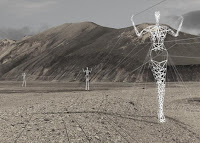
-- a _kt75 | reprint   Tweet   Renewable energy sources, at least wind and solar, are variable — the wind isn’t always blowing, the sun isn’t always shining. This is something every glib pundit on the internet cites as a reason we’ll need fossil-fuel or nuclear “baseload” power plants for the foreseeable future. It’s a frustrating topic, since people who actually study the subject (like NREL) have shown that there are all sorts of ways to handle variability without disrupting the grid. One of those ways is transmission : building power lines to take renewable energy from where it is abundant (often remote areas) to where it is needed (mainly big cities). More specifically, the idea is to build high-voltage direct-current (HVDC) lines that would carry energy over long distances from remote sites and feed it into the alternating-current (AC) lines that serve urban areas. (The DC vs. AC question is interesting, but not particularly essential...

Black or White? Why Germany's 'Energy Turnaround' needs Reconsideration

Image
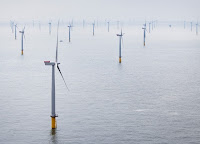
-- a _kt75 | reprint     Tweet The cornerstones of Germany's energy turn-around can be admired in a hall in the northern port city of Bremerhaven. Standing on three rust-brown feet apiece, each of these immense, yellow-painted trunks weighs as much as 900 elephants. Soon, special ships will come and sink these steel monsters into the seabed, where they will support the wind turbines that are supposed to supply the country with green electricity. Before they do, Environment Minister Peter Altmaier will go to Bremerhaven to inspect the work of Weser Wind and Areva Wind, the companies building them. Areva calls these wind-turbine supports "tripods." Peter Altmeier has a more poetic term, dubbing them "cathedrals to industrial culture." This last week, there was a strict division of labor at several locations around the country. From Monday to Wednesday, the environment minister went on a whirlwind tour of Germa...

Simply the Best?
How sustainable are Renewable Energy Carriers in Reality?

Image
-- a _kt75 | note     Tweet Renewable (Alternative) Energy Carriers: Hydro, Solar, Wind Power, etc. Non-Renewable (Conventional) Energy Carriers: Nuclear, Coal, Gas, Oil Power, etc. Pros: Pros: + Zero GHG emissions: true -except in case of water dams- but excludes indirect GHG emissions, e.g. from upstream production/assembly processes + Stable energy supply + Little waste problem: basically true -except in case of solar modules (PV) + Efficient + endless availability: true -but energy generation fluctuates depending upon carrier presence (e.g. calm winds, droughts, sun shine, etc.) + Less costly than renewable energy ... ... Cons: Cons: - Contribution to GHG emissions: water dams -> read more - Seriously impact the climate (global warming, climate change): fossil fuels like coal and gas - Impact on land scape: water dams, wind and solar parks - Serious EoL problem: nuclear waste - Technological immaturity: low efficiency of e.g. solar panels - Non-renewa...

Moneytalks: ... on the Economic Aspects of Water Dams

Image
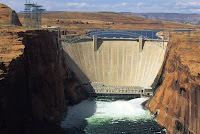
-- a _kt75 | reprint compilation   Tweet Reprint: Large dams have long been promoted as providing "cheap" hydropower and water supply. Today, we know better. The  costs and poor performance of large dams were in the past largely concealed by the public agencies that built and operated the projects. Dams consistently cost more and take longer to build than projected. In general, the larger a hydro project is, the larger its construction cost overrun in percentage terms. The true risks and costs of dams are being forced into the open due to increasing public scrutiny and attempts to attract private investors to existing and new projects. The World Commission on Dams found that on average, large dams have been at best only marginally economically viable. The average cost overrun of dams is 56%. This means that when a dam is predicted to cost $1 billion, it ends up costing $1.56 billion. In too many cases, the burden of uneconomic dams is...

Have a break? Have a Problem: on the Risk of Large Hydro Power Dams

Image
-- a _kt75 | reprint   Tweet Since long before the Pyramids towered above the rich soil of this riverside town, Egyptians have given thanks to the muddy waters of the Nile. "Plants, animals, humans," said Ibrahim Abdel Aziz, a 45-year-old farmer, "we all come from this river." Trace the Nile about 2,250km upstream and there's a rising colossus that threatens to upset a millennia-old balance. There, in the Ethiopian highlands, one of the world's largest dams is taking shape. For Ethiopia , the dam promises abundant energy and an escape from a seemingly permanent spot in the lowest rungs of the world's human development index. But for Egypt , the consequences could be dire: a nationwide water shortage in as little as two years that causes crop failures, power cuts and instability resonating far beyond even the tumult of the recent past. For a country facing daily domestic crises in the aftermath of its 2011 revolution,...